5 best AI personal trainer apps for beginners in 2026 (prices compared)
If you've never been to a gym before, "AI personal trainer" is a confusing category. Half the apps that claim it are actually preset programs with a chatbot bolted on. The other half assume you already know how to bench press, what a deload week is, and how to read a 1RM table. Neither is what a beginner needs.
This guide reviews the five AI personal trainer apps a true beginner should actually consider in 2026. Pricing, what each one is best at, and — critically — where each one falls short. We're the team behind Trainer Gym AI (one of the apps reviewed), so the bias disclosure is upfront. We've tried to make the comparison honest enough that the article would be useful even if you ended up picking a competitor.
Bottom line
| If you want… | Pick |
|---|---|
| The cheapest beginner-friendly AI plan that explains every exercise | Trainer Gym AI ($9.99 one-time) |
| Maximum exercise library + algorithmic depth, intermediate-friendly | Fitbod (~$80/year) |
| AI plans + a human coach checking your form | Caliber (free tier + paid coaching) |
| Bodyweight or home workouts with AI personalization | Freeletics (~$80/year) |
| 1-on-1 premium coaching, money no object | Future (~$199/month) |
If you're a total beginner reading this guide because you don't know what to do at the gym yet, your shortlist is Trainer Gym AI and Caliber. The other three are excellent apps; they just expect more from you on day one.
What to look for in an AI personal trainer app (as a beginner)
After testing every major AI fitness app for this guide, five criteria separated the beginner-friendly ones from the rest:
- The onboarding asks plain-English questions. "What's your goal?" beats "Enter your 1RM in kg." Apps that demand technical input upfront silently filter out beginners.
- Every exercise has a video or animated GIF. Reading "barbell hip thrust 3×8" doesn't help if you've never seen one. The app needs to show you.
- The plan adapts when you can't do something. Beginner gyms vary wildly — some have full racks, some have only dumbbells, some are hotel basements with one machine. Apps that can't substitute exercises will quickly become unusable.
- Rest timers, set tracking, and progression are automatic. The cognitive load on a first-time gym visit is enough. The app should handle the bookkeeping.
- Pricing is transparent and not predatory. Fitness apps are notorious for trial-to-subscription traps and tier-locking basic features. A clear one-time fee or a single transparent subscription is a green flag.
With those criteria in mind, here's the lineup.
#1 — Trainer Gym AI
Best for: People who have never set foot in a gym and want guidance, not a blank workout log.
Price: $9.99 one-time (R$49.90 in Brazil). No subscription.
Platform: iOS and Android.
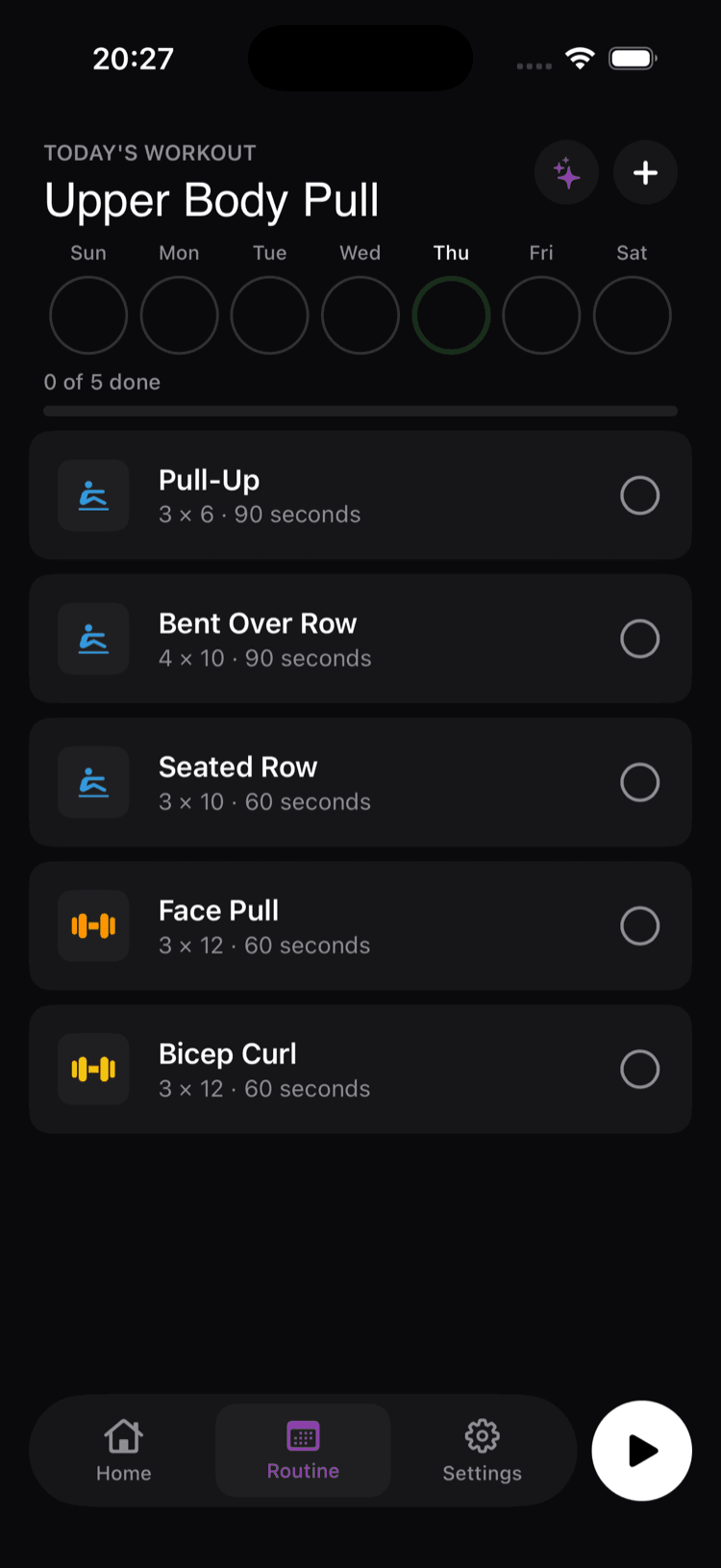
The pitch. Trainer Gym AI is built specifically for the "I don't know what to do at the gym" moment. Onboarding takes about a minute and asks 9 plain-English questions: what's your sport (gym, running, yoga, combat, CrossFit, calisthenics, sport-specific, or rehabilitation), what equipment do you have access to, your age, weight, height, training frequency, and primary goal. The AI generates a complete plan from there — exercises with animated GIFs, sets, reps, rest timers, and a Live Activity that ticks down on your iPhone Lock Screen between sets. Every finished workout writes to Apple Health automatically.
What it does well. The price point is the obvious headline — $9.99 once is roughly 1/8 the price of Fitbod's annual subscription and a rounding error compared to Future. But the more interesting differentiator for beginners is the onboarding philosophy: the questions are designed to be answerable by someone who has never touched a barbell. On iOS, the on-device 3D form-check feature (using Apple's Vision framework) is also rare in this category — competitors generally don't include any form correction at all, or charge extra for human review.
Where it falls short. The exercise library is smaller than Fitbod's — you'll find fewer exotic equipment variations. And being a newer app, its store review count is modest compared to apps that have been available for nearly a decade. Live Activities, HealthKit, and 3D form check are iOS-specific features.
Skip if: You're an intermediate or advanced lifter looking for granular control over volume, periodization phases, or RPE-based loading. Trainer Gym AI's plans are designed for people who don't know what those things are.
#2 — Fitbod
Best for: Gym-goers who already know the basics and want a deep adaptive algorithm.
Price: Around $79.99/year or $12.99/month (varies by region and promo).
Platform: iOS, Android, and web.
The pitch. Fitbod has been the default answer to "what's the best AI gym app" for years, and the reputation is earned. Its adaptive algorithm tracks muscle recovery, available equipment, and your workout history to generate the next session's plan. The exercise library is enormous — virtually any equipment variation you can name is in there.
What it does well. The recovery-aware planning is genuinely sophisticated. If you smashed legs Monday, Fitbod won't put you under a heavy squat on Wednesday. The exercise demonstrations are clean and consistent, and the iPad / web versions are particularly well-built for tracking.
Where it falls short. Fitbod assumes you already speak gym. The onboarding asks for your one-rep max and weights for each exercise — fine for an intermediate, intimidating for a beginner. The pricing is also subscription-only, with the annual plan saving meaningful money over monthly but locking you into a year (here's the full Fitbod pricing breakdown and five cheaper Fitbod alternatives). There's no Brazilian Portuguese support.
Skip if: You're brand new to the gym and need an app that can be your teacher, not just your tracker.
#3 — Caliber
Best for: Beginners who want AI-driven plans plus the option of a human coach checking in.
Price: Free tier with paid coaching (~$199/month for full coaching, lower tiers available).
Platform: iOS, Android, web.
The pitch. Caliber pairs an AI-driven training app with optional one-on-one human coaches. The free tier is fully functional for tracking and getting structured plans; the paid tiers add a real coach who reviews your form videos and adjusts your program.
What it does well. The free tier is unusually generous — you can use Caliber as a beginner-friendly tracker without paying anything, and graduate to a coach when you're ready to spend. The strength-training programming is solid and beginner-aware: it ramps you in rather than dumping a hypertrophy split on day one.
Where it falls short. The full Caliber experience is one of the more expensive options if you go for human coaching, and the free tier is more "good tracker with structured templates" than "AI personalization that adapts." The mobile app is well-designed but the brand is less established than Fitbod or Future, so the App Store review count is smaller.
Skip if: You only want pure AI personalization and don't care about the human-coach upsell path.
#4 — Freeletics
Best for: People who don't want to (or can't) go to a gym.
Price: Around $79.99/year (varies; promotions are frequent).
Platform: iOS, Android, web.
The pitch. Freeletics is the OG of AI-personalized bodyweight training. Its "Coach" feature has been generating adaptive plans for nearly a decade. Recently it's expanded gym support, but the bodyweight / minimal-equipment angle is where it shines.
What it does well. If you want to train at home with no equipment or a single set of dumbbells, Freeletics's plans feel personal — they ramp difficulty, swap exercises based on what you completed, and have an unusually motivating tone. The German engineering shows through in the interface polish. Multiple language support including Portuguese, Spanish, French, German.
Where it falls short. For traditional gym strength training (barbell squat, bench, deadlift, overhead press), Freeletics is less of an obvious fit than Fitbod or Trainer Gym AI. The "tone" of the app is HIIT/conditioning-flavored, which not everyone wants.
Skip if: You specifically want to lift at a gym and progress on the big compound lifts.
#5 — Future
Best for: People who can spend $200/month for a real human coach delivered through an app.
Price: Around $149-199/month depending on coach.
Platform: iOS, Android.
The pitch. Future is technically not "pure AI" — it pairs you with a real human strength coach who programs your week, reviews your form videos, and texts you about your training. The AI elements show up in workout tracking, planning interfaces, and analytics, but the heart of the product is the human accountability.
What it does well. Accountability. Knowing a real person is going to see whether you trained this week is one of the strongest behavioral interventions in fitness. The coaches are credentialed, the programming quality is high, and the user experience is among the best in the category.
Where it falls short. $200/month is roughly 20× the lifetime price of Trainer Gym AI, and most beginners don't have that budget for a fitness app. If you're starting out, the value-per-dollar of a paid human coach is hard to justify when much cheaper apps will get you 80% of the way there.
Skip if: Your budget is anything less than premium, or you don't actually need accountability — you'll feel guilty about money you didn't have to spend.
Side-by-side
| Feature | Trainer Gym AI | Fitbod | Caliber | Freeletics | Future |
|---|---|---|---|---|---|
| Beginner-friendly | Yes | No | Yes | Partial | Partial |
| AI workout generation | Yes | Yes (strong) | Partial | Yes | Hybrid |
| On-device form correction | Yes (iOS) | No | No | No | Human review |
| Native Portuguese (PT-BR) | Yes | No | No | Partial | No |
| Apple Watch / HealthKit | Yes | Yes | Yes | Yes | Yes |
| Android | Yes | Yes | Yes | Yes | Yes |
| One-time purchase | Yes ($9.99) | No | No | No | No |
| Subscription | None | ~$80/yr | ~$199/mo | ~$80/yr | ~$199/mo |
Prices are accurate as of May 2026 and may change.
How to pick
Walk through these questions in order:
- iOS or Android? All five support both; compare features, price, and whether you need web or wearable support.
- What's your monthly fitness budget? Less than $10/month: Trainer Gym AI, Caliber's free tier. $10-20/month: Fitbod or Freeletics. $50+/month: any of the coached options.
- Where will you train? Full gym: Trainer Gym AI, Fitbod, Caliber, or Future. Home with no equipment: Freeletics. Mix: Trainer Gym AI or Caliber.
- Do you actually need accountability? Be honest. If you'll genuinely train without someone watching, save the Future money. If you won't, Future is the most effective option in the list.
For a complete beginner on iOS or Android with a normal budget, the recommendation is Trainer Gym AI. Pick Caliber if a free tier matters more than native Portuguese or one-time ownership. For an intermediate who wants the deepest algorithm, choose Fitbod; for at-home training, Freeletics; for accountability, Future.
FAQ
What does "AI personal trainer" actually mean? The honest answer: it varies. Most apps in this category use a mix of rule-based templates plus some adaptive logic on top of an LLM (like GPT or Claude) that personalizes plans to the inputs you give. None of them are AGI-level personal trainers. They're decision-support systems that produce reasonable workouts faster than a human could, at a fraction of the price.
Are AI fitness apps as good as a human personal trainer? For most beginners, no — but they're 80% as good for under 5% of the price. A human trainer's edge is real-time form correction and motivation, neither of which apps fully replace. AI's edge is consistency, infinite variation, and being available at 6 AM when no human trainer would be.
Do I need an Apple Watch to use these apps? No. All five work standalone on a phone. An Apple Watch makes timer feedback nicer (haptic taps) but is optional.
Is the free tier of any of these apps usable? Caliber's free tier is the most genuinely usable — you can track and follow structured plans without paying. Trainer Gym AI is free to download; iOS includes a 7-day trial and Android includes the first plan generation, followed by a one-time lifetime unlock. The other three apps have trial periods that convert to paid.
Can I cancel after the trial? Yes for all of them, but pay attention to auto-renewal dates. Fitbod, Freeletics, and Future all use App Store/Play Store subscriptions — cancel through your platform's subscription settings, not the app itself. Trainer Gym AI has nothing to cancel since it's one-time.
Bottom line
If you've never been to a gym, you'd likely be best served by Trainer Gym AI ($9.99 once) for its beginner onboarding and price point, or Caliber's free tier if paying nothing matters most. Both produce a complete workout plan that explains every exercise, manages rest timers, and progresses you over time without demanding that you already speak gym.
The right answer changes if you want extreme depth (Fitbod), at-home bodyweight (Freeletics), or premium accountability (Future). But for the specific case of "I'm starting out and I want an AI to tell me what to do today," the cheap and beginner-focused options are where the value is.