How AI personal training actually works (without the hype)
The phrase "AI personal trainer" hides a wide range of underlying tech. Some apps are mostly templates with branding. Others run real LLM pipelines and computer-vision models. Most users — including many who pay for these apps — couldn't tell you which is which.
This guide walks through what's actually happening when you tap "generate plan." It explains the inputs, the model, the outputs, and — importantly — the boundaries. Where AI does the job genuinely well. Where it falls short and a human coach is still better. Why the price gap between an app and a coach is so dramatic. And how to evaluate whether any given app is doing real AI work or just dressing up presets.
Bias upfront: we build one of these apps (Trainer Gym AI). We've tried to write this without product pitching — the goal is for you to understand the category well enough to pick the right tool.
What "AI personal trainer" actually means
There are roughly three flavors of AI in the fitness app category, in increasing order of sophistication:
Tier 1: Templates with smart routing
The simplest. The app has 50-200 pre-built programs (5×5 strength, push-pull-legs hypertrophy, beginner full-body, etc.) and routes you to one based on a few questions. There's no real generation — your "personalized plan" is a template that exists for thousands of users with similar inputs.
This is what most "AI fitness app" branding actually delivers. It works fine if the templates are well-designed. It's not really AI in the sense most users imagine.
Tier 2: LLM-generated plans from inputs
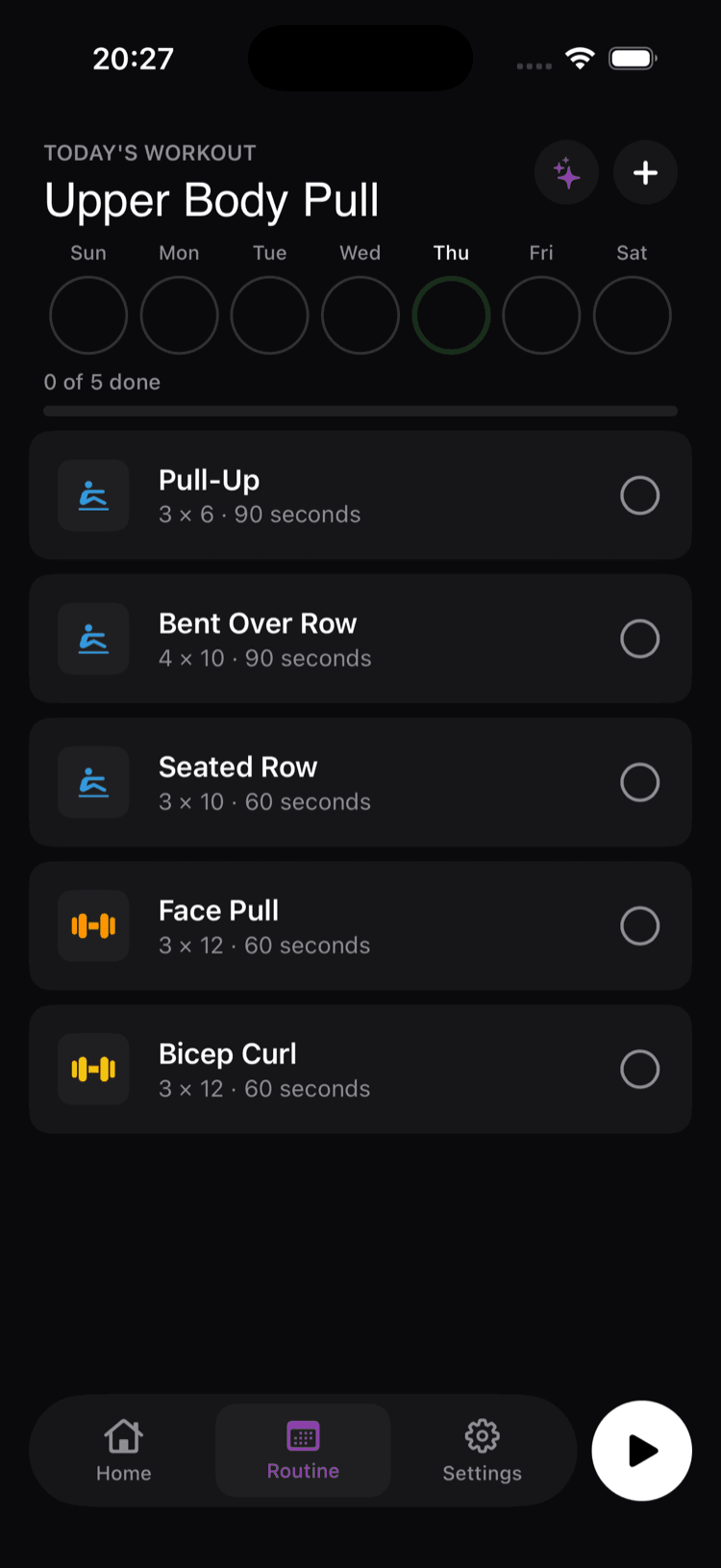
The second tier uses a large language model (GPT, Claude, or Gemini) to generate a workout plan from your specific inputs. The app sends the LLM a structured prompt like:
Generate a 4-week training plan for: a 32-year-old, 75kg male, gym strength training, 4x/week, equipment available: barbell, dumbbells, cable machine, no leg press; goal: hypertrophy with maintained strength; experience: 6 months. Return as structured JSON with weekly splits, exercises, sets, reps, and rest periods.
The LLM produces a plan that's genuinely tailored to those inputs — different from what it would produce for a 50-year-old beginner or a 25-year-old powerlifter. Quality depends on the prompt engineering and on the safety rails the developer puts in.
This is what apps like Trainer Gym AI do. It's also what some Fitbod features have evolved toward.
Tier 3: LLM + adaptive learning + computer vision
The most sophisticated. LLM-generated plans, plus an algorithm that adapts the plan based on what you actually did (modifies next session if you skipped, slept badly, or progressed faster than expected), plus computer-vision models that analyze form videos.
Fitbod's recovery-aware planning is partial Tier 3. Future's coaches use Tier 3 tools to support their human work. Trainer Gym AI's on-device 3D pose form check is Tier 3. No app is fully Tier 3 across all dimensions yet.
When you read "AI personal trainer," ask which tier the app is operating at. The answer is usually somewhere between Tier 1 and Tier 2.
What the AI considers when generating a plan
A well-built Tier 2 app considers, in roughly this priority order:
- Goal. Hypertrophy, strength, fat loss, general fitness, or sport-specific conditioning. The same person gets meaningfully different plans depending on this single answer.
- Experience level. Beginner programs are full-body 3x/week with compound lifts and a slow ramp. Intermediate is split routines with progressive overload. Advanced involves periodization phases. Mismatching the level produces either injury (too much) or no progress (too little).
- Equipment. Limits the exercise pool. A hotel room with no equipment ≠ a fully-loaded commercial gym.
- Frequency. 2x/week vs 6x/week determines whether you can split body parts, do full-body, or run a split where chest gets hit twice.
- Body composition. Age, weight, height influence loading and volume.
- Injuries / restrictions. A bad shoulder rules out overhead pressing. A bad knee rules out heavy squats.
- Recovery state (Tier 3). If you trained hard yesterday, today's plan considers what's recovered.
The plan is generated by the LLM as text. The app then parses the text into structured exercises, validates that each one is in its exercise database, and presents it to you as a workout you can follow.
Where AI is genuinely better than human
A few places AI beats most human personal trainers:
- Consistency. A human coach has bad days. The AI's "tone" doesn't degrade because it had a fight with its partner.
- Variation. The AI can generate hundreds of plan variations a week without getting bored. A human coach has a finite mental library of programs and tends to repeat their favorites.
- Cost. A human personal trainer in the US costs $50-150/session. The AI is $5-20/month. Twenty sessions of human coaching equals ~5 years of an AI app.
- Availability. The AI is awake at 6 AM on Christmas. No human trainer is.
- Privacy. Form-check via on-device computer vision means the app sees your video. No human reviewer, no cloud upload, no embarrassment about training in your living room.
Critically: AI is better than no coaching at all by a wide margin. For someone who would never hire a human coach, the comparison isn't AI-vs-coach — it's AI-vs-nothing.
Where AI still falls short
A few places where a human coach still wins:
- Real-time correction. A coach in the room watches your set, calls out a cue mid-rep, makes you redo the last two with better form. AI form check approaches this but can't yet match a human's eye for subtle cueing.
- Motivation. Knowing a real person is going to ask "why did you skip Tuesday?" is a different kind of accountability than a notification you can dismiss.
- Injury rehab. Genuine injury programming is medical-adjacent and benefits from human judgment. Most apps disclaimer their way out of this and they're right to.
- Reading the room. A human coach notices you're stressed and dials back today's session. AI doesn't (yet — Tier 3 sleep/HRV inputs are starting to help).
- Outliers. The 90th percentile of training scenarios — competitive athletes, post-surgery, complex chronic conditions — are still human-coach territory.
If you're in any of these categories, an app augments but doesn't replace a coach.
How form-correction AI works
A specific sub-category worth understanding because it's where AI got dramatically better in 2024-2026.
Modern phones (iPhone 12+, recent Pixel and Samsung Galaxy) have hardware sufficient to run real-time pose-detection models. Apple's Vision framework, Google's MediaPipe, and similar libraries can identify 33 body landmarks (shoulders, elbows, wrists, hips, knees, ankles, etc.) at 30+ frames per second.
A form-check feature stacks on top of this:
- The camera captures you doing the exercise
- The pose model identifies your joint positions in 3D space
- The app compares your joint angles and trajectories to known-good reference data for that exercise
- When something is off — e.g., knees collapsing inward on a squat — the app surfaces a real-time cue
Critically: this runs entirely on your phone. No video uploads. No coach reviews your gym videos. The whole computation happens in the device's neural engine in real time.
Trainer Gym AI's iOS app does this for compound lifts using Apple's Vision framework. Most other AI fitness apps don't have a form-check feature at all. A few have human-coach video review (Future), which is more accurate but slower (24-48h turnaround) and costs more.
How to tell if an app is doing real AI work
A few diagnostic questions:
- Does the plan change meaningfully when you change your inputs? Set up the app with one profile, then a second time with very different inputs (different equipment, different goal, different experience level). If the plans are clearly different, it's real generation. If they're suspiciously similar, it's templates.
- Does the app explain its reasoning? Some apps surface the why ("we're loading shoulders today because you trained back-and-bicep yesterday"). This is a sign the planning logic is real.
- Does the app degrade gracefully on weird inputs? If you say "I have a torn rotator cuff and want to bench press heavy," what does the app do? Real systems either substitute or warn. Templates plow ahead.
- Is the developer transparent about the AI? Apps doing real LLM work generally say so, including which model and what kind of guardrails. Apps using "AI" as marketing typically can't tell you what's behind the curtain.
FAQ
Should I trust an AI to write my workout plan? For general fitness, hypertrophy, and strength training as a non-competitive lifter — yes. The plan an AI generates is almost certainly better than what you'd write for yourself, because it draws on a broader body of training science. For specific medical or competitive contexts, supplement with a human professional.
Which model does Trainer Gym AI use? The plan-generation pipeline runs against the latest GPT model (gpt-5.4-mini at time of writing) with XML-structured prompts and three layers of input/output validation. On iOS, form check is on-device using Apple's Vision framework — your video never leaves your phone.
How is AI cheaper than a human coach if it's running on GPT? Each plan generation uses a few thousand tokens of GPT — roughly $0.001-0.005 in API cost. Spread over a year of an app subscription or a one-time purchase, the per-user economics work out fine. The limiting factor is the developer's compute and engineering budget, not the AI inference cost.
Are AI fitness plans peer-reviewed? The plans themselves aren't, but a well-built AI app's prompts are anchored in peer-reviewed exercise science. Trainer Gym AI's prompt set draws on 17 meta-analyses across volume, frequency, rest periods, and progression schemes.
Will AI replace personal trainers entirely? No. AI takes over the bottom 80% of personal training (program writing, exercise selection, basic progression). The top 20% — competitive athletes, complex injuries, real-time hands-on coaching — stays human. The gap closes slowly, but probably never fully.
Bottom line
AI personal training is real, getting genuinely better, and is the right tool for most people who would never hire a human coach. It's not magic — what's behind the curtain is an LLM doing structured plan generation plus, in the best apps, a computer vision model checking your form on-device. Pick an app whose tier matches your needs and budget. For most beginners, a Tier 2 app at $5-15/month does the job a human coach would do at $500-2000/month.